No One Left Outside the Gates: How Disabled Gamers Are Rewriting the Rules of Access
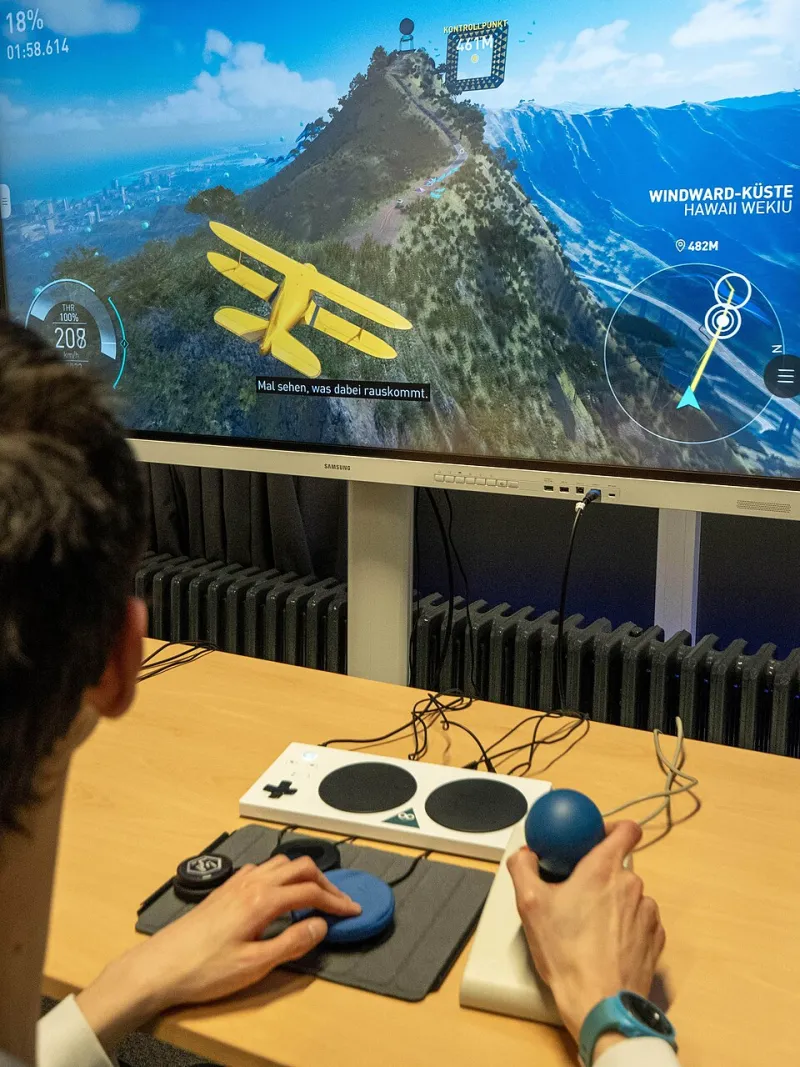
Photo: InclusiveGameLab, CC BY-SA 4.0, via Wikimedia Commons
Every fortress has a drawbridge. The question is who gets to cross it.
For millions of disabled gamers in the US, that drawbridge has historically been stuck — not out of malice, necessarily, but out of something almost worse: indifference. Controllers designed for two fully functional hands. Menus with no colorblind options. Games that punish you for not having split-second reflexes. The industry spent decades building bigger and better worlds without stopping to ask who was being left outside the gate.
That's changing. Slowly, unevenly, and often only because disabled players refused to stop knocking.
The Xbox Moment That Changed the Conversation
If there's a single turning point most people point to, it's the 2018 launch of the Xbox Adaptive Controller. Microsoft didn't just release a peripheral — they released a statement. The XAC is a large, flat device with two massive programmable buttons and a row of 3.5mm jacks that let users plug in virtually any external switch, joystick, or assistive device they already own. It was built in direct collaboration with organizations like AbleGamers, SpecialEffect, and The Cerebral Palsy Foundation.
The marketing campaign that followed — featuring real disabled gamers, not actors — hit different. It went viral not because it was slick, but because it felt honest. Parents of kids with limb differences were crying at a Microsoft ad. That doesn't happen by accident.
But hardware is only part of the story. The deeper shift has been in software, and that battle is still being fought.
Settings Menus as Accessibility Infrastructure
Walk into the options menu of a modern AAA title and you're increasingly likely to find things that didn't exist five years ago: toggles to turn off flashing lights, options to remap every single button, the ability to slow down or pause combat, high-contrast modes, and subtitle customization that goes way beyond font size.
The Last of Us Part II became something of a benchmark here. Naughty Dog shipped the game with over 60 accessibility features — screen readers, lock-on aiming, the ability to adjust enemy aggression, navigation assistance for players with low vision. It wasn't perfect, but it set a new bar that the rest of the industry had to reckon with.
More recently, games like Forza Horizon 5 added full American Sign Language and British Sign Language support in cutscenes. God of War: Ragnarök launched with robust options for motor, vision, and hearing accessibility baked in from day one rather than patched in later — which, frankly, is how it should always work.
The difference between accessibility as an afterthought and accessibility as a design pillar is enormous, and players can feel it.
When the Industry Falls Short, Gamers Build Their Own Solutions
Here's the part the press releases don't cover: for every game that gets it right, there are dozens that don't. And disabled gamers have spent years becoming their own engineers out of necessity.
Take the modding community around PC gaming. Players with motor disabilities have built custom AutoHotkey scripts to automate button combinations that would otherwise require two hands. Blind players have created screen reader mods for games that shipped with zero audio cues. Communities on forums like Reddit's r/disabledgamers and the AbleGamers forums are full of DIY solutions — 3D-printed controller mounts, foot pedal setups, eye-tracking rigs cobbled together from off-the-shelf components.
One player, a US Army veteran who lost partial use of his right hand, documented building a one-handed controller setup using a combination of the Xbox Adaptive Controller, a Titan Two adapter, and a custom 3D-printed joystick housing. His YouTube tutorial has hundreds of thousands of views. He shouldn't have had to make it — but he did, and now others don't have to start from scratch.
That's the bittersweet reality of the accessibility community in gaming: it's incredibly resourceful precisely because it's been forced to be.
Indie Devs Are Quietly Leading the Charge
Big studios get the headlines, but some of the most thoughtful accessibility work is happening in smaller shops. Celeste — an indie platformer about climbing a mountain — added an "Assist Mode" that let players adjust game speed, grant themselves infinite stamina, or skip chapters entirely. The developer, Maddy Thorson, was explicit: this wasn't a "cheat mode." It was an acknowledgment that not every player has the same physical capabilities, and that everyone deserves to experience the story.
The backlash from some corners of the internet was predictable and exhausting. The support from disabled players was overwhelming and real.
Smaller studios often have more freedom to make these calls without a committee signing off on every decision. They're also, increasingly, staffed by developers who grew up in a more diverse gaming culture and don't see accessibility as a liability or a niche concern. It's just... part of making a good game.
The Standards Fight Nobody's Winning Yet
Despite real progress, the industry still lacks unified accessibility standards. Unlike web development — where WCAG guidelines give designers a concrete framework — game developers are largely working from voluntary best practices and community-driven resources like the Game Accessibility Guidelines website.
Advocacy organizations have been pushing for more. AbleGamers' Accessible Player Experiences (APX) framework offers detailed guidance. SpecialEffect, a UK-based charity with significant US reach, works directly with developers and provides free equipment to disabled players who need it. But adoption is inconsistent, and there's no regulatory pressure in the US equivalent to what the ADA does for physical spaces.
Some advocates argue that's the next frontier — that accessibility in gaming needs the same kind of structural push that made wheelchair ramps and closed captioning standard. Others worry that heavy regulation could stifle smaller developers who genuinely can't afford extensive accessibility testing. It's a real tension, and there's no clean answer.
The Fort Belongs to Everyone
Here's the thing about building a fortress: you can make it as grand and well-defended as you want, but if huge portions of your community can't get through the door, you haven't built something to be proud of. You've just built a very expensive wall.
Disabled gamers aren't asking for the games to be made easier. They're asking for the tools to engage with them on their own terms. That's a completely reasonable request — and increasingly, the industry is starting to hear it.
The progress is real. The gaps are also real. And the players who've spent years hacking together their own solutions deserve more than a slow clap. They deserve an industry that meets them where they are, not one that makes them prove their right to be here.
The drawbridge should be down. For everyone. That's what a real gaming community looks like.