Same Couch, Same Screen, Way More Fun: The Local Multiplayer Comeback Nobody Saw Coming
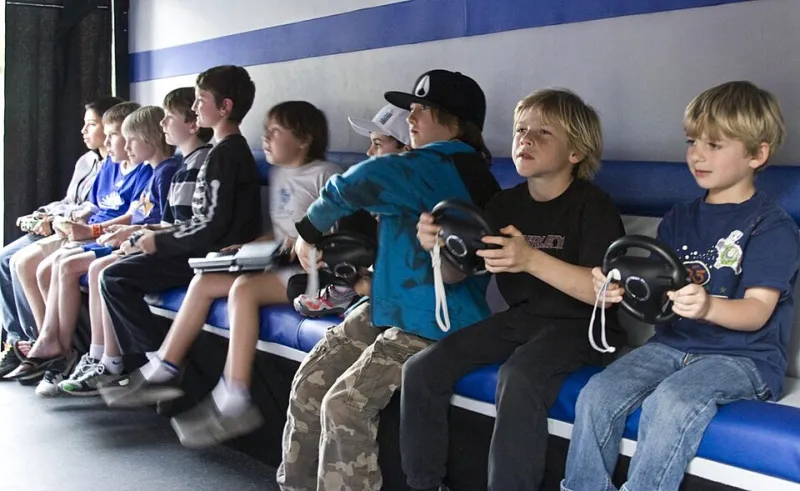
Photo: Gamesingear, CC BY-SA 3.0, via Wikimedia Commons
There's something that happens when you hand someone a controller and sit next to them. The trash talk is louder. The victories feel shared. The losses sting in a way that somehow brings people closer together. It's a vibe that a Discord call — no matter how good the connection — has never quite managed to replicate.
For a long time, it felt like that experience was getting quietly phased out. Online multiplayer exploded, broadband became a household staple, and the industry largely followed the money. Split-screen modes got cut. Couch co-op features vanished from sequels that used to include them. The living room setup started looking more like a solo command center than a gathering spot.
But something shifted. Local multiplayer is back, it's louder than ever, and the gaming community is clearly hungry for it.
How We Got Here
To understand the comeback, you have to understand why local multiplayer faded in the first place. The economics made sense at the time — online gaming opened up massive, monetizable player bases. Developers could build one experience and sell it to millions of people playing in isolation across the country. Why spend resources on split-screen infrastructure when you could just build dedicated servers instead?
The problem is that something real got lost in the trade-off. Gaming became more connected globally and less connected locally. You could squad up with strangers in Tokyo but struggle to find a game to play with your college roommate sitting three feet away.
Fast forward to the early 2020s, and a few things collided at once. Pandemic lockdowns pushed people to find entertainment at home with whoever they were stuck with. Zoom fatigue made the idea of yet another screen-mediated social interaction genuinely exhausting. And a wave of indie developers — many of them raised on the golden age of couch co-op — started building games specifically designed around physical togetherness.
The Indie Vanguard Leading the Charge
If you want to understand who's driving this renaissance, look at the indie scene. Studios like Devolver Digital, Raw Fury, and a dozen smaller outfits have been quietly building a local multiplayer library that rivals anything the major publishers put out in the genre's heyday.
Games like It Takes Two, Overcooked, Cuphead, Lovers in a Dangerous Spacetime, and Moving Out didn't just sell well — they became cultural touchstones. People filmed themselves playing them. Parents played them with their kids. Couples used them as date night activities. These weren't fringe products; they were genuinely mainstream hits that proved the demand was there all along.
What these games share is intentional design around shared physical space. They're built so that two people on the same couch aren't just tolerating each other's presence — they actually need each other. Communication, coordination, and a little bit of chaos are baked into the mechanics. That's a fundamentally different design philosophy from most online multiplayer games, where the social layer is almost incidental to the core loop.
The Fort Mentality: Gaming as a Shared Space
Here at VG Fort, we talk a lot about gaming as a community experience — a place where people gather, compete, and build something together. Local multiplayer is maybe the purest expression of that idea. Your living room becomes the fort. The people on your couch are your crew. The outside world can wait.
There's a reason people get nostalgic about the era of four controllers plugged into a Nintendo 64 or a PlayStation 2. It wasn't just the games — it was the physical ritual of it. Dragging chairs from the kitchen. Arguing about who gets to be Player 1. The collective groan when someone accidentally unplugged the console.
That tactile, in-person quality is something online gaming genuinely cannot reproduce, and a growing number of players seem to be recognizing it. According to various community surveys and platform data, interest in local co-op features has been climbing steadily, particularly among players in their late 20s and 30s who grew up with the format and are now looking to share it with partners, kids, or old friends.
Console Makers Are Paying Attention
The hardware side of the industry has started catching up. Nintendo, honestly, never really let go of local multiplayer — the Switch was practically designed around it, with detachable Joy-Cons built for exactly this use case. Mario Kart, Super Smash Bros., and countless third-party titles made the Switch a legitimate couch co-op machine from day one.
Sony and Microsoft have been slower to lean in, but the signals are there. Both platforms have expanded their family sharing and local account features, making it easier for multiple players to game together on one console. More developers are being asked — and in some cases contractually required — to include local multiplayer modes in games that receive platform promotional support.
The conversation has shifted. Local multiplayer is no longer seen as a legacy feature for small-budget titles. It's increasingly treated as a legitimate selling point, something that differentiates a game in a crowded market.
What Players Are Actually Saying
Spend any time in gaming communities online — Reddit threads, Discord servers, gaming forums — and you'll find a consistent undercurrent of players expressing fatigue with the purely online experience. Toxic lobbies, connectivity issues, skill-gap frustration with strangers, the loneliness of playing alongside people you'll never actually know — these complaints come up constantly.
Local co-op sidesteps most of them. When the person next to you beats you, it's funny. When you fail together, you laugh about it. The emotional texture of playing with someone physically present is just different, and players who've rediscovered it tend to sound almost evangelical about it.
Family gaming, in particular, has become a major driver. Parents who grew up gaming in the '90s and 2000s are now actively seeking out couch co-op titles to share with their kids. It's one of the few entertainment formats that genuinely works across age gaps without requiring the younger player to grind through a skill curve alone.
The Road Ahead
None of this means online multiplayer is going anywhere. Competitive gaming, live service titles, and massive online worlds are still enormous parts of the industry and show no signs of slowing down. But the idea that local multiplayer was a dying format has clearly been proven wrong.
The developers who never stopped believing in it are now being vindicated by the market. The players who kept asking for split-screen in sequels that dropped it are finally getting some answers. And the living room — that original gaming fort — is reclaiming its place as one of the best places to play.
Grab a controller. Pass one to somebody next to you. The couch co-op era isn't coming back — it's already here.